
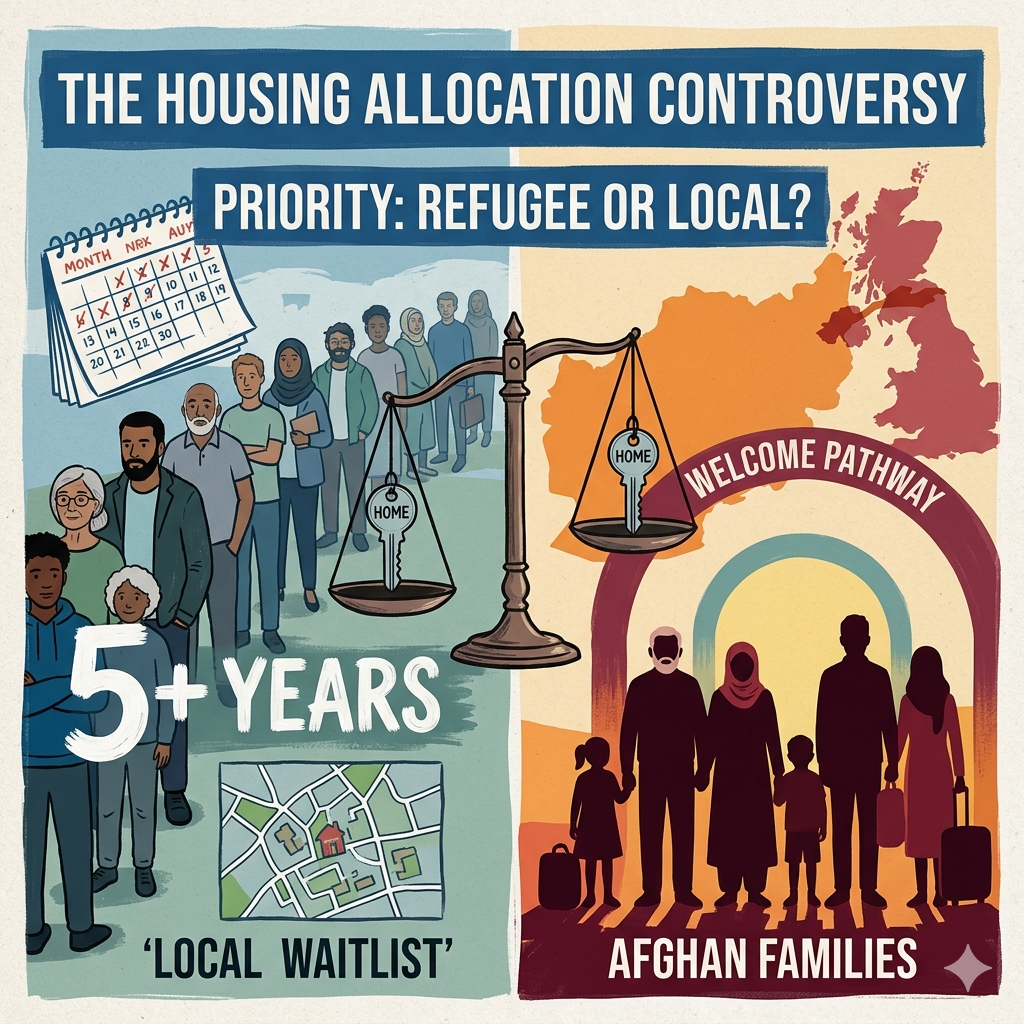
Housing Allocation Controversy: Should Afghan Families Be Prioritised Over Long-Waiting LocalResidents?
The recent Cabinet decision under the Local Authority Housing Fund (LAHF) 4 has reignited a deeply contentious debate: should Afghan refugee families be prioritised for housing over local residents who have, in many cases, waited years on housing lists?
Under the LAHF4 scheme, Dorset Council has approved £662,000 in capital funding alongside £4,796 in revenue funding to support the purchase of four properties.
These homes will be delivered through Bournemouth Churches Housing Association (BCHA), with a deadline for completion set at 31 March 2027.
Crucially, the funding conditions require that these properties are allocated to Afghan families, who must be offered secure tenancies.
This is not an isolated initiative. Dorset Council has previously acquired 30 properties under earlier phases of the scheme.
However, unlike previous arrangements where the council retained ownership, LAHF4 requires the involvement of a registered provider to meet tenancy requirements—highlighting both a policy shift and operational constraint.
The Human Context Often Overlooked
It is important to recognise who these Afghan families are. Many are the families of individuals who directly supported British forces during operations in Afghanistan—working as interpreters, guides, or in other high-risk roles alongside UK personnel.
Their association with British forces placed them in significant danger following the withdrawal, making relocation not simply a humanitarian gesture, but a response to a specific obligation.
This reality complicates the narrative. These are not random allocations, but part of a national resettlement effort tied to military and political commitments. For supporters of the policy, this strengthens the argument that prioritisation is justified.
On paper, this reflects a moral and political commitment to support those displaced by conflict. However, at a local level, the implications are far more complex—and uncomfortable.
For many residents, the issue is not a lack of compassion. Dorset communities have historically shown willingness to support those in need.
The tension arises when this support appears to come at a direct cost to local people—families, elderly residents, and vulnerable individuals who have spent years navigating an overstretched housing system.
Critics argue that prioritising Afghan families risks undermining trust in the fairness of housing allocation.
When individuals who have contributed to the local area for decades see newcomers
placed ahead of them, it creates a perception—fair or not—of institutional imbalance.
This perception can quickly evolve into resentment, eroding social cohesion.
Yet this framing does not resolve the core dilemma: housing is a finite resource. Every allocation decision inherently involves trade-offs.
When supply cannot meet demand, prioritisation becomes a zero-sum game.
A more critical question emerges—should national commitments be fulfilled through local housing systems already under strain?
Or should central government provide separate, dedicated housing solutions to avoid direct competition with local need?
There is also a practical dimension. The LAHF model requires collaboration with housing
associations to provide secure tenancies, highlighting structural limitations within councils that do not directly manage housing stock.
While operationally necessary, this adds another layer of complexity and cost.
Ultimately, this issue is not simply about “locals versus refugees.” It is about transparency, fairness, and trust.
Policies that fail to acknowledge the lived reality of those waiting—sometimes for
years—risk deepening divisions.
If councils are to maintain public confidence, they must confront this tension openly.
That means clearly communicating why decisions are made, how trade-offs are managed, and what steps are being taken to expand housing supply for everyone.
Avoiding the controversy does not make it disappear. Addressing it honestly might.