
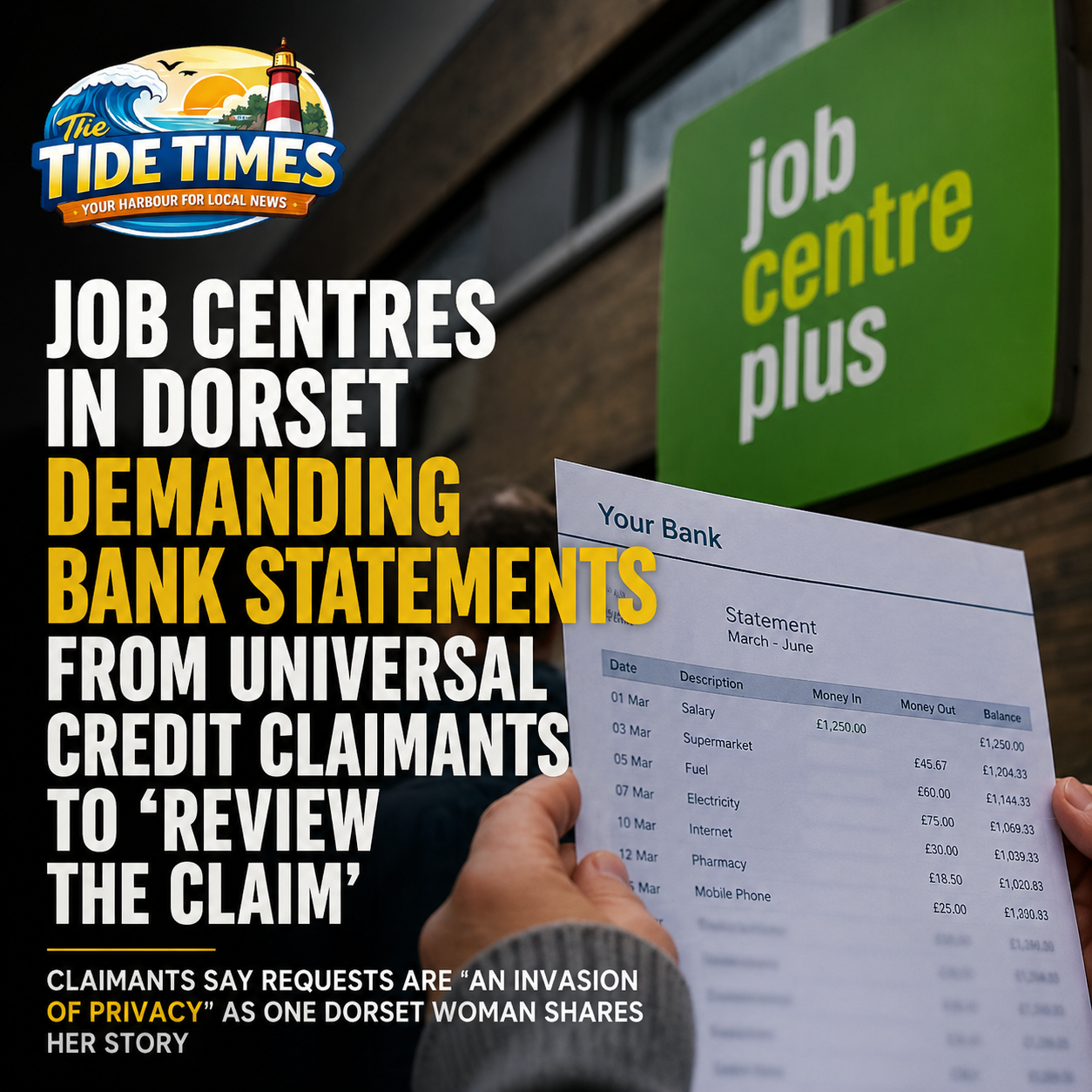
Jobcentres in Dorset Request Bank Statements from Universal Credit Claimants
Concerns are growing among claimants in Dorset after reports that Jobcentres are increasingly requesting detailed bank statements as part of routine checks on those receiving Universal Credit.
Under current rules, the Department for Work and Pensions (DWP) is permitted to carry out periodic “claim reviews” to ensure individuals are receiving the correct level of support. As part of these reviews, claimants may be asked to submit bank statements and other financial evidence.
What Powers Do Jobcentres Have?
According to official government guidance, claimants can be asked to provide bank statements during a review process. The purpose is to verify income, savings, and overall financial circumstances, ensuring that payments are accurate and that no relevant details have been omitted.
These checks stem from regulations under the Welfare Reform framework, which allows the DWP to request “information or evidence” necessary to assess entitlement.
In practice, this means:
- Claimants may be asked for several months of bank statements
- Transactions are reviewed to confirm income, savings thresholds, and financial activity
- Reviews can result in increased payments, reductions, or no change at all.
While this process is positioned as a safeguard against error and fraud, it is increasingly being felt on the ground as intrusive and, in some cases, excessive.
Claimant Experience Raises Questions
We spoke to one Dorset claimant, Sarah, who asked not to have her surname published. After more than 15 years in continuous employment, she lost her job in February and made a claim for Universal Credit shortly afterwards.
She described her experience:
“They demanded four months of bank statements, which includes time when I was still in employment before my claim. How can they justify that?”
Sarah’s case highlights a key concern: the scope of the requests. While the DWP’s stated aim is to assess current entitlement, claimants are sometimes asked for financial records that pre-date their claim entirely.
The Argument Against: Privacy and Proportionality
Critics argue that while the DWP has legal authority to request financial information, the extent and intrusiveness of these requests raise serious ethical questions.
Bank statements reveal far more than income and savings. They can expose:
- Personal habits and spending choices
- Medical payments or sensitive purchases
- Relationships, locations, and lifestyle patterns
For many, this level of scrutiny feels disproportionate—particularly for individuals who have recently entered the benefits system after long periods of employment.
There is also concern about “function creep”—where powers granted for fraud prevention expand into routine surveillance of ordinary claimants.
In Sarah’s case, the inclusion of pre-claim financial history raises a fundamental question of fairness:
- If eligibility begins at the point of claim, why is earlier financial behaviour being examined?
Critics argue that such practices risk undermining trust in the welfare system, turning what should be a support mechanism into what feels like an investigative process.
A System Under Pressure
Universal Credit, introduced under the Welfare Reform Act 2012, was designed to simplify the benefits system and ensure accuracy in payments.
However, the increasing use of financial scrutiny reflects a broader tension:
- The government’s drive to reduce fraud and error
- Versus claimants’ expectations of dignity and privacy
Conclusion
There is no dispute that the DWP has the legal power to request bank statements during a Universal Credit review. But legality does not automatically equate to fairness.
For claimants like Sarah, the issue is not just compliance—it is proportionality.
As more people across Dorset and beyond report similar experiences, the debate is shifting from whether the government can ask to whether it should be asking in this way at all.