
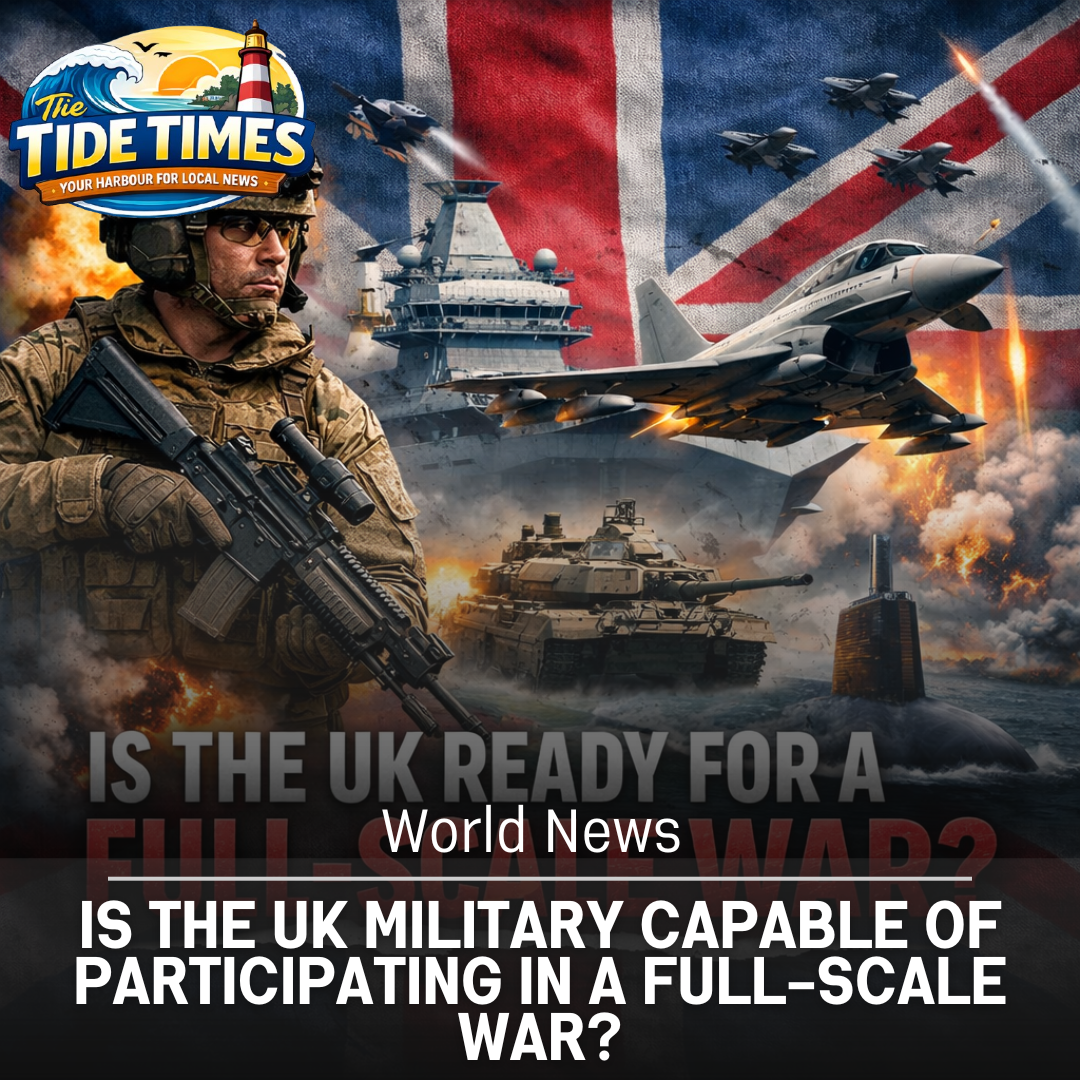
Is the UK Military Capable of Participating in a Full-Scale War?
The question of whether the United Kingdom could meaningfully participate in a full-scale, high-intensity war has become increasingly relevant amid rising global tensions. From the war in Ukraine to instability in the Middle East and the Indo-Pacific, the strategic environment facing United Kingdom is more complex than at any time since the Cold War.
This article examines the structure, strengths, and limitations of the UK’s armed forces in the context of modern large-scale warfare.
Strategic Context
The UK is a founding member of NATO and operates under a collective defence framework. Unlike during the world wars, Britain is not expected to fight alone in a major conflict. Its military doctrine is built around alliance warfare — particularly alongside the United States and European partners.
However, the scale of modern warfare — especially as seen in Ukraine — has reignited debate about force size, industrial capacity, and sustainability.
Force Structure Overview
The UK Armed Forces consist of three main branches:
- The British Army
- The Royal Navy
- The Royal Air Force
Each maintains professional, technologically advanced forces, but at reduced numbers compared to Cold War levels.
The British Army: Professional but Limited Mass
The British Army is highly trained and experienced, with combat deployments in Iraq and Afghanistan over the past two decades. However, troop numbers have declined significantly. As of the mid-2020s, regular personnel stand at just over 70,000 — the smallest size since the Napoleonic era.
Heavy armour has also been reduced. The UK is upgrading its Challenger tanks to the Challenger 3 standard, but total numbers remain modest compared to large continental armies.
In a prolonged high-intensity conflict, questions arise around:
- Depth of reserves
- Ammunition stockpiles
- Replacement of equipment losses
- Industrial mobilisation capacity
While capable of deploying a division-sized force, sustaining it in prolonged, attritional warfare would be challenging without allied reinforcement.
The Royal Navy: High Capability, Small Fleet
The Royal Navy remains one of the most capable naval forces in Europe. Its centrepiece assets are the two Queen Elizabeth-class aircraft carriers, including HMS Queen Elizabeth. These carriers allow the UK to project power globally using F-35B aircraft.
The UK also maintains a continuous at-sea nuclear deterrent through ballistic missile submarines.
However, fleet size is limited:
- A small number of destroyers and frigates
- Limited escort capacity for carrier strike groups
- Dependence on allied navies for sustained global operations
In a full-scale maritime war against a peer adversary, force protection and logistics would be critical constraints.
The Royal Air Force: Advanced but Finite
The Royal Air Force (RAF) fields advanced combat aircraft including the Typhoon and F-35B. It also contributes to NATO air policing missions and maintains strategic lift and intelligence capabilities.
The RAF would likely play a key role in:
- Air superiority
- Long-range strike
- Intelligence, surveillance, and reconnaissance
- Support to ground forces
Yet aircraft numbers are not large, and attrition in a peer conflict could quickly reduce operational capacity without rapid industrial replacement.
Nuclear Deterrence
The UK retains an independent nuclear deterrent based on submarine-launched ballistic missiles. This capability ensures that any existential threat would carry severe consequences for an adversary.
While nuclear weapons are unlikely to be used in conventional warfare, their existence fundamentally shapes strategic calculations and enhances deterrence credibility.
Industrial and Logistical Considerations
Modern high-intensity warfare consumes enormous quantities of ammunition, drones, missiles, and spare parts. The war in Ukraine has demonstrated the scale required to sustain operations over months and years.
The UK’s defence industrial base is advanced but not currently structured for rapid mass wartime production. Reconstitution of stockpiles would depend heavily on:
- Domestic manufacturing expansion
- Allied supply chains
- Financial mobilisation
Recent government commitments aim to increase defence spending and replenish munitions, but scaling up takes time.
Alliance Warfare: The Decisive Factor
The UK does not plan to fight a large-scale war independently. Within NATO, it contributes high-end capabilities rather than mass manpower. Its comparative advantages include:
- Carrier strike
- Nuclear deterrence
- Special forces
- Advanced air power
- Intelligence integration with the US
In a full-scale NATO conflict — for example involving Russia — the UK would likely play a critical but supporting role within a broader coalition.
Overall Assessment
The UK military remains technologically advanced, professional, and globally deployable. It can credibly participate in a full-scale war — particularly as part of NATO — but would face limitations in sustained, high-casualty, industrial-scale conflict.
Key constraints include:
- Force size
- Ammunition stockpiles
- Industrial depth
- Long-term sustainability
The central question is not whether the UK can fight — it can. The more pressing issue is whether it can sustain high-intensity combat over extended periods without rapid expansion of resources and industrial mobilisation.
In the modern era, capability is measured not just by technology, but by resilience.